Who is
Muhammad Ahmad?
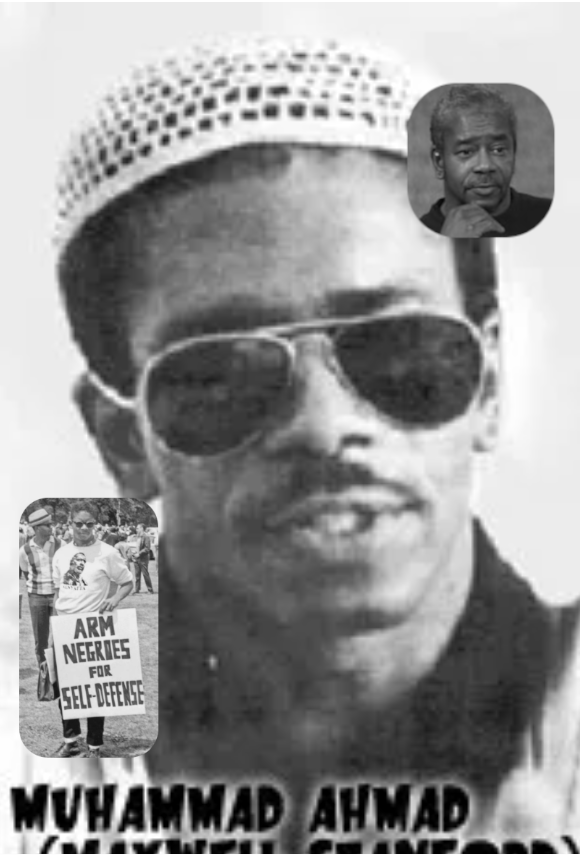
Dr. Muhammad Ahmad is a living legend of the Black freedom movement of the 1960s and 1970s. He was a key architect of the movement's shift from non-violent, passive resistance, to more militant forms of direct action against American-style Apartheid in the Northern and Southern United States. Ahmad worked with pioneering thinkers and practitioners of Black Nationalism and self-defense to develop the basic worldview and methods of struggle employed by the youth who created the Black Power Movement.
Born in Philadelphia in 1941, Muhammad came of age during the early civil rights struggle. His reflections of that time include discussions with his father about the Montgomery Bus Boycott and its significance as a watershed moment of Black unity. Ahmad’s father, Maxwell Curtis Stanford, Sr., was a self-declared “Race Man,” and one of the few NAACP members who backed the armed self-defense strategy of Robert F. Williams. Max Stanford, Jr., as Ahmad was known as a student activist, would become a key operative within the nationwide network of radicals who supported Williams and his wife Mabel when they fled to Cuba escaping an FBI dragnet in 1961. This network included seasoned veterans of the Black freedom struggle like former Garveyite Queen Mother Moore and Nation of Islam spokesman Malcolm X.
Malcolm fused the armed self-defense tactics that Robert Williams pioneered with a global perspective of worldwide conflict. On one side, he cleverly dissected the dying system of international white supremacy. On the other side, he championed the nations of Africa, Asia and Latin America fighting for liberation, and believed the freedom of Black people in the US was intimately linked to their potential victory. As the Muslim minister popularized his critique of the Black movement’s worldview and aims, Ahmad helped organize a network of radical students, veteran organizers (both communists and Black nationalists) and Black military veterans to develop a political alternative to the liberal, pacifist civil rights movement – one that advocated self-defense and sought national liberation as opposed to integration into the US Empire.
The Revolutionary Action Movement was an outgrowth of these efforts. It was the first organization to emerge out of the 1960s generation of Black freedom fighters to declare Revolution – the Black Revolution – as it’s aim. It is a little known fact that RAM members like Muhammad helped form the Organization of Afro-American Unity, which Malcolm sought to use as a vehicle to broaden the tactics, aims and ideological scope of the struggle. While Malcolm’s plans were disrupted by an assassination plot orchestrated by the US government, it was young Black militants like Muhammad who carried on his work.
Ahmad was one of many Northern radicals who went into the South to work with local militants who diverged from Dr. Martin Luther King’s non-violent philosophy to form organizations like the Deacons for Defense. A year after Malcolm was murdered, the Black Power slogan emerged from the depths of Mississippi and powerfully captured the tanglible aims of this new direction. Young activists of the Student Non-violent Coordinating Committee also helped form the Lowndes County Freedom Organization in Alabama, which was a prototype for what would become the Black Panther Party.
Muhammad played a pivotal role in forming the first organization to call itself the Black Panther Party in Harlem in July 1966, several months before the organization that gained international notoriety in Oakland, California. The nickname had been adopted by the Lowndes County group, which used the jet black, feline predator native to Africa as its symbol. This bold imagery struck the imagination of America’s Black youth like lightning. Ahmad would form close relationships with both groups and went on to help create other organizations such as the League of Revolutionary Black Workers, the Republic of New Afrika, the Afrikan People's Party, and the African Liberation Support Committee.
In the course of his activities, Muhammad suffered relentless government persecution, physical attacks and long periods of imprisonment. He survived what many call the Second American Revolution, or Second Civil War – which destroyed legally codified white supremacy. He has made it his mission to document past history and help forecast future developments as a firsthand witness to earth-shattering events. Muhammad went on to obtain advanced degrees in history and political science and has remained active in the social justice movements. However, the Muhammad Ahmad Library Foundation will be his lasting legacy to Black people and our freedom-loving allies. It is his offering to the world to enjoy, share and contribute as we struggle.